10 AI Visibility Tools to See what AI Says about your Brand

Your next customer might ask ChatGPT for a shortlist before they ever open Google. The question is whether your brand makes the cut.
Try it yourself. Ask an AI assistant to recommend products in your category. Then change the budget, location or use case. Does your brand still appear? Does a competitor get a better description? Does the answer link to a source you have never heard of?
That is where AI visibility tools earn their place. They help you track how brands appear in AI-generated answers, investigate cited sources and spot gaps that a traditional rankings report can miss.
Choosing one takes a little homework, though. A tool built for monitoring a handful of prompts serves a different purpose from an enterprise platform with content agents and traffic analysis.
Here are 10 options worth considering, with a practical look at what each brings to the job.
What is an AI visibility tool?
An AI visibility tool measures how a brand or website appears in responses from AI platforms such as ChatGPT, Gemini and Perplexity, or search features such as Google AI Overviews.
Depending on the product, it can help answer questions like:
- Does our brand appear for the questions buyers ask?
- Which competitors get recommended alongside us?
- How does AI describe our products or services?
- Which websites get cited in the answers?
- Is our visibility changing over time?
A mention, a citation and a visit are different outcomes. An answer can name your company without linking to it. A link can appear without sending a visitor. Keep those distinctions in mind when comparing dashboards.
1. AI Visibility Tool
AI Visibility Tool is an AI visibility tracking software that helps businesses and agencies monitor AI brand mentions, track prompts, and analyze citations in AI-generated answers.
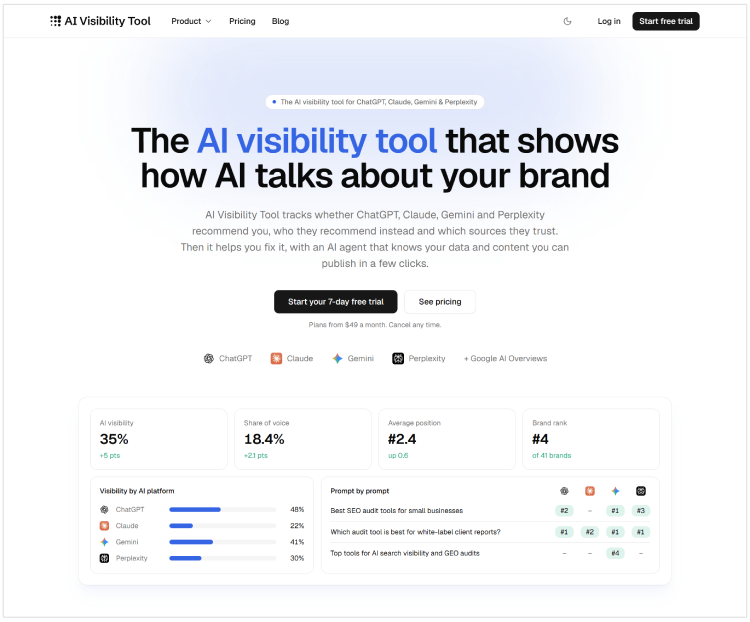
The AI tracker combines AI search analytics with sentiment and brand perception analysis to show where your brand appears, which sources AI cites, and how AI describes your business. An integrated AI Agent lets you explore your visibility data and ask questions in plain English.
For example, a software brand might want to know whether AI associates it with small businesses, enterprise buyers or a particular feature. A search visibility score alone cannot explain that positioning.
What can you track?
Its features include weekly tracking for individual prompts and an AI Overviews Tracker for monitoring where Google's AI Overviews cite your website. Citation analysis helps identify referenced sources, while sentiment and perception analysis examine how AI talks about your brand.
The AI Agent adds a conversational way to explore the data. You can ask questions in plain English, with connected analytics, Search Console, rankings and page data supporting the analysis. Content tools also cover research, outlining and writing.
Who is it for?
Marketers and agencies that want visibility tracking, brand interpretation and AI-assisted investigation in one workflow.
Pricing
AI Visibility Tool starts at $49/month for the Starter plan, which includes 25 tracked prompts and one brand.
Pro costs $99/month for 100 prompts and three brands, while Advanced is $199/month for 300 prompts and 10 brands.
Every plan tracks ChatGPT, Claude, Gemini and Perplexity, with sentiment, perception and citation analysis, plus AI Agent and AI Writer access.
Annual billing saves 25%, and a free trial is available.
2. OtterlyAI
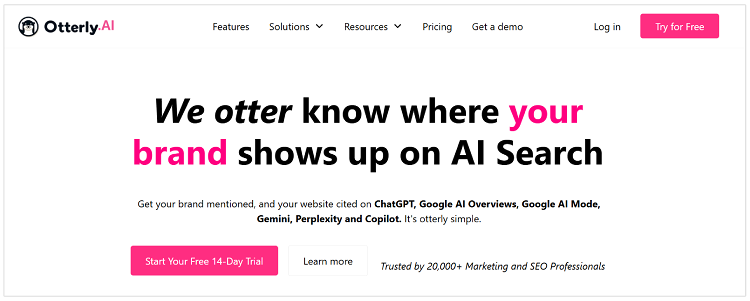
OtterlyAI has a relatively low entry price, making it worth considering for an initial monitoring project. Its features include brand visibility monitoring, sentiment analysis and citation source tracking.
What can you track?
Available engines include ChatGPT, Perplexity, Microsoft Copilot, Gemini, Claude, Google AI Overviews and Google AI Mode. Its November 2026 packaging update lets new users choose at least three engines, with prompt capacity depending on the selection and plan.
That flexibility is useful when your audience cares more about some platforms than others. Check the engine combination you actually need before comparing prompt allowances.
Who is it for?
Solo marketers and smaller teams that want a manageable starting point for AI search monitoring.
Pricing
Lite starts at $29/month, Standard at $189/month, and Premium at $489/month. Enterprise pricing is custom.
3. Peec AI
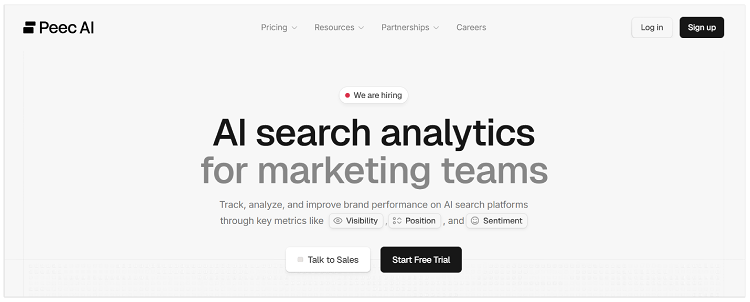
Peec AI lets teams examine brand visibility, position, sentiment and share of voice across topics, models and competitors. That makes it a useful candidate for teams that need to investigate performance beneath an overall score.
What can you track?
Available platforms include ChatGPT, Perplexity, Gemini, Google AI Overviews and Google AI Mode. Standard brand plans let you choose three active models.
Source analytics help identify the domains and URLs appearing in answers. The platform also provides gap analysis and recommended actions, with AI visibility reporting and integration access varying by tier.
Who is it for?
SEO and content teams that want a repeatable way to compare their brand with competitors and investigate which subjects need attention.
Pricing
Starter costs $95/month for 50 prompts, three active models and one project. Pro is $245/month, and Advanced is $495/month. Unlimited users are included on those plans.
4. Profound
Profound combines answer engine optimization with prompt research, agent analytics and AI marketing workflows. Its enterprise offering is built around a tailored deployment rather than a single fixed monitoring allowance.
What can you track?
The Enterprise plan supports tailored tracking across up to 10 answer engines. Available options include ChatGPT, Perplexity, Gemini, Claude, Google AI Overviews and Google AI Mode.
Answer Engine Insights examines brand and competitor appearances. Agent Analytics covers AI-sourced traffic and attribution, while Prompt Volumes supports research into what people ask answer engines.
Who is it for?
Enterprise teams that need AI search data to feed broader research, reporting and recurring marketing workflows.
Pricing
Paid Enterprise packages use custom pricing. A free seven-day trial includes 50 prompts run daily across ChatGPT, Gemini and Google AI Overviews, plus limited AI Marketer credits.
5. Scrunch
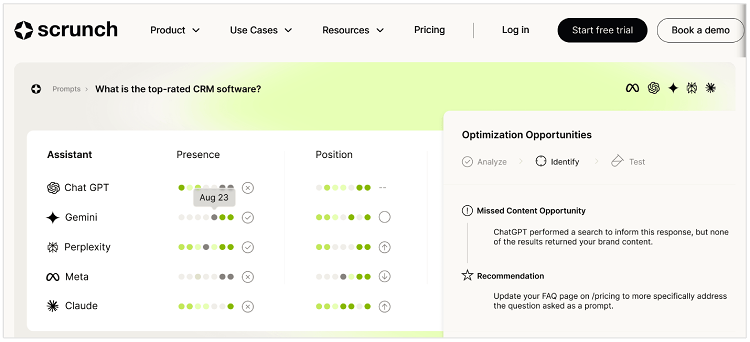
Scrunch combines AI answer monitoring with page audits and agent-traffic monitoring. Its separate AXP offering generates an AI-friendly version of a site for AI-driven experiences; confirm its commercial scope when evaluating a package.
What can you track?
Coverage includes ChatGPT, Claude, Gemini, Perplexity, Google AI Mode, Google AI Overviews and Meta.
Features include prompt monitoring, citation tracking, content-gap insights, personas and performance reporting. Page audits provide another route into investigating visibility problems beyond the answers themselves.
Who is it for?
Marketing teams that want to examine AI responses alongside website accessibility, content issues and AI-driven visits.
Pricing
Starter costs $300 month-to-month, or $250/month billed annually. It includes 350 custom prompts, three user licenses and five page audits. Growth and custom Enterprise packages are also available.
6. AthenaHQ
AthenaHQ pairs prompt and response analysis with source insights, competitor research, content recommendations and optimization features. It is worth evaluating if your team wants measurement and follow-up tasks in the same product.
What can you track?
Starter coverage includes ChatGPT, Perplexity, Gemini, Claude, Copilot, Google AI Overviews and Google AI Mode, among other platforms.
The plan offers country-level support, unlimited topics and prompts, and competitor tracking. Usage still depends on credits: one AI response uses one credit. “Unlimited prompts” therefore does not mean unlimited collection.
Who is it for?
Teams prepared to move from identifying visibility gaps into on-page, off-page and content optimization work.
Pricing
Starter is $295/month, with 3,600 credits and optional paid add-ons for API access and extra credits. A limited free Essential option and custom Enterprise packages are available.
7. Promptwatch
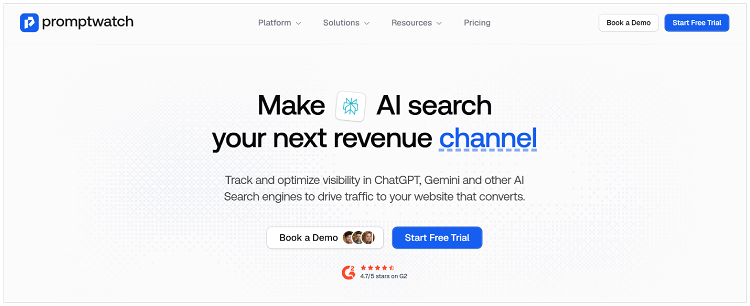
Promptwatch combines visibility monitoring with agent chat, content-gap analysis and content workflows. Higher tiers add more publishing capacity, location detail and technical capabilities.
What can you track?
Supported options include ChatGPT, Perplexity, Claude, Gemini, Google AI Overviews and Google AI Mode, with four tracked models included in its published standard packages.
The platform offers competitor analysis and country-level tracking. Agent analytics, content production allowances and more granular location tracking depend on the plan.
Who is it for?
Marketing teams looking to connect monitoring with ongoing content and technical work, rather than exporting every finding into a separate process.
Pricing
Essential starts at $95/month for one project, 50 prompts and 6,000 responses. Professional is $245/month, while Business is $579/month. Essential does not include AEO articles.
8. Semrush AI Visibility Toolkit
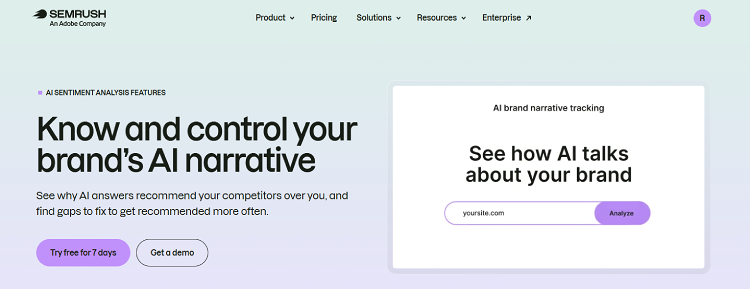
The Semrush AI Visibility Toolkit includes brand-performance analysis, competitor research, prompt research and custom prompt tracking. It also includes site checks for AI readiness.
What can you track?
Semrush lists coverage for ChatGPT, Google AI, Gemini and Perplexity. Its reports help investigate mentions, citations, sentiment and competitor gaps.
One distinction matters when buying: broad domain-analysis reports and the prompts you explicitly monitor have different limits. Check both against your intended workflow.
Who is it for?
SEO teams that want to incorporate AI search monitoring into an established Semrush workflow, or evaluate a combined SEO and AI search subscription.
Pricing
The standalone toolkit starts at $99/month per domain, with 25 custom prompts and one domain for Brand Performance analysis. Additional prompts and domains cost extra.
9. Ahrefs Brand Radar
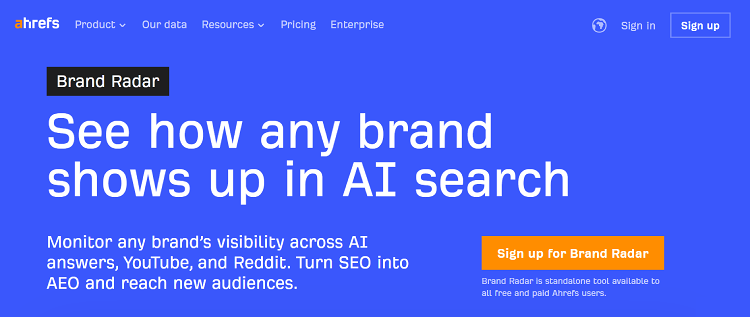
Ahrefs Brand Radar adds a broader research angle through its AI visibility indexes, alongside custom prompt tracking. That makes it worth considering when you want to explore a category before deciding what to monitor.
What can you track?
Custom tracking covers platforms including ChatGPT, Perplexity, Gemini, Copilot, Google AI Overviews and Google AI Mode. Index access lets you research brand appearances beyond your own tracked set.
Treat database research and custom monitoring as separate purchasing decisions. The cheapest custom package does not include every AI index.
Who is it for?
SEO specialists and researchers who want broader competitive discovery as well as a defined set of prompts to track over time.
Pricing
Custom prompt packages start at $50/month for 2,500 checks. AI index access is listed at $199/month per platform, or $699/month for all platforms.
10. Writesonic
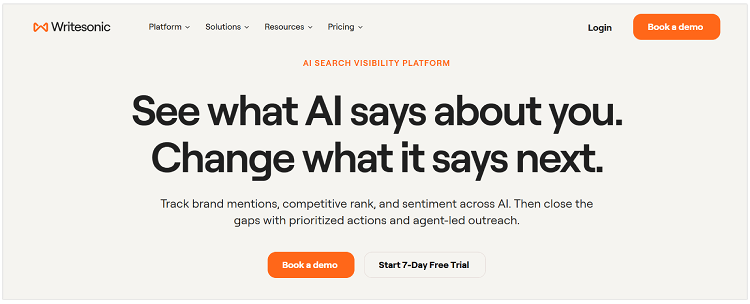
Writesonic combines AI search tracking with article creation and site audits. The appeal is the connection between finding a gap and producing material to address it—provided the output still goes through proper research and editorial review.
What can you track?
Starter tracks ChatGPT, Gemini and Google AI Overviews, with 50 prompts and 150 answers tracked daily.
Broader coverage, including Perplexity, Claude and Google AI Mode, is listed under Enterprise. Sentiment analysis starts on Growth, so check feature access rather than assuming everything appears in the entry plan.
Who is it for?
Content teams that want AI search monitoring alongside writing and audit tools, and can use the included production allowances.
Pricing
Starter is $79/month billed annually, including 15 AI articles per month and 10 site audits of up to 100 pages each. Higher tiers expand usage and features.
How to choose an AI visibility tool without buying more than you need
The longest feature list is not automatically the best fit. Start with the decisions you need the data to support.
Build a prompt set that resembles real buying questions
Include category discovery, comparisons, specific use cases and branded questions. For an AI recruiting product, that might mean:
- “Which AI recruiting tools suit a small hiring team?”
- “What should I use to screen technical candidates?”
- “What are the alternatives to [brand]?”
- “Does [brand] integrate with our applicant tracking system?”
A prompt set made entirely of questions containing your brand name can give you a comforting but narrow view of discovery.
Compare the actual cost of your setup
Write down the platforms, locations, tracking frequency and number of prompts you need. Then price that configuration.
One hundred prompts checked daily across four platforms can represent roughly 12,000 responses in a 30-day month. Vendors package that workload differently, so compare included responses or checks as well as headline prompt limits.
Look beneath the score
Ask whether you can inspect the collected answers and cited URLs. A percentage is easier to interpret when you can see the responses behind it.
Also check how the tool defines visibility, position, sentiment and share of voice. Similar labels do not guarantee identical calculations.
Decide who will act on the findings
If your team already has a strong research and content process, focused monitoring may be enough. If findings regularly stall after reporting, integrated analysis and content workflows could be more valuable.
Either way, assign someone to investigate changes, verify claims and decide what work follows.
Which AI visibility tool should you choose?
Start with the question you need answered.
If you want to understand both brand presence and how AI describes your business, AI Visibility Tool is worth exploring. For a smaller initial monitoring project, consider OtterlyAI. For broader category research, examine Ahrefs Brand Radar.
Enterprise teams with several departments using the data may want a closer look at Profound or Scrunch.
Then test your shortlist against the same prompts and business questions. Look at the answers, the sources and the decisions each tool helps you make.
Your goal is to leave the report knowing what deserves attention next.